Katja Washington · 21 November 2026
Polish Research Groups Streamline Project Funding Through Azure Analytics Linked to Emerging Green Certification Standards
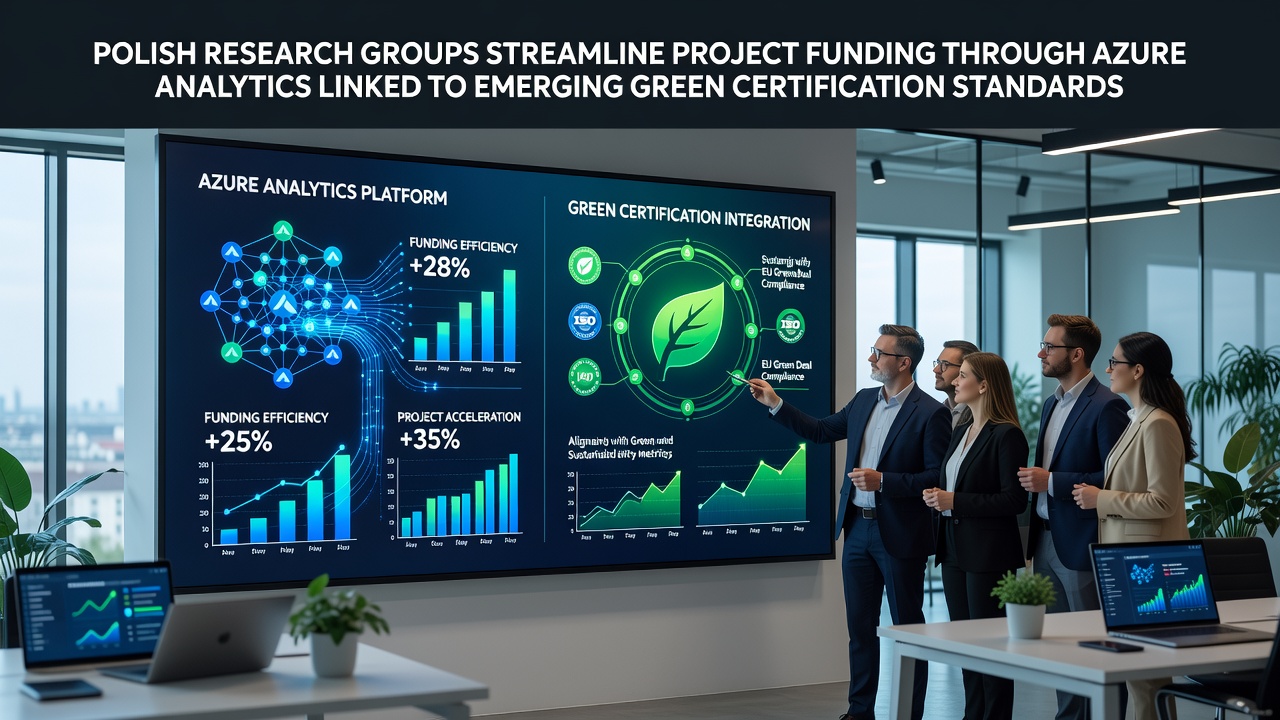
Polish research institutions have integrated Azure Analytics platforms with project funding workflows, and this shift aligns directly with new green certification standards that emerged across European funding bodies in recent years. Universities in Warsaw, Krakow, and Wroclaw began adopting these tools to track resource allocation while meeting environmental benchmarks required for grant approvals. Data from the Polish Ministry of Science and Higher Education shows increased use of cloud-based analytics since 2024, when several national programs tied funding eligibility to sustainability reporting. Researchers process large datasets on energy consumption, material sourcing, and carbon outputs through Azure tools, which generate compliance reports automatically. These reports feed into certification processes under frameworks like the EU Green Deal tracking mechanisms. Observers note that the connection reduces manual paperwork, since analytics dashboards pull real-time metrics from lab equipment and supply chains.Integration of Analytics With Certification Requirements
Funding applications now require evidence of green practices, and Polish groups link Azure Analytics outputs to those criteria. The system monitors variables such as server energy use and travel emissions tied to collaborative projects. According to figures released by the European Environment Agency, similar data-driven approaches in other member states have cut administrative review times by up to 30 percent.
Teams configure Azure dashboards to flag deviations from certification thresholds, which allows project leads to adjust plans before submission deadlines. In one documented case at Jagiellonian University, researchers connected sensor data from experimental facilities directly to certification portals, and this setup produced verifiable reports within hours instead of weeks. The process also incorporates external benchmarks from bodies like Environment and Climate Change Canada, which supplies comparative metrics on sustainable lab operations.Funding Streamlining Mechanisms
Azure Analytics handles budget forecasting by modeling multiple funding scenarios against green targets. Polish consortia running joint projects across institutions use shared workspaces to consolidate spending data, and the platform highlights areas where efficiency gains support certification scores. November 2026 brought an update from Microsoft that expanded these capabilities with new modules for tracking renewable energy offsets, and several Polish groups incorporated the features immediately.
Grant administrators at the National Science Centre in Poland report that applications using Azure-linked analytics pass initial screening faster because documentation arrives pre-validated against certification checklists. The approach draws on patterns observed in Australian research funding models, where similar analytics reduced rejection rates for sustainability-linked proposals.

Case Examples From Polish Institutions
At the University of Warsaw, a physics research cluster combined Azure cost management tools with green certification tracking for a particle detection project. The group mapped equipment power draw against funding tranches and generated reports that satisfied both national and EU reviewers. Data indicates this method secured an additional funding round by demonstrating measurable reductions in operational emissions.
Another example comes from Gdansk University of Technology, where marine biology teams applied analytics to vessel fuel logs and lab sample processing. The resulting certification documentation aligned with emerging standards from the European Maritime Safety Agency, and project timelines shortened because funding releases occurred without repeated queries for clarification.
Technical Setup and Data Flows
Implementation typically begins with Azure Data Factory pipelines that ingest information from university ERP systems and environmental sensors. Power BI visualizations then display progress toward certification milestones alongside budget utilization rates. Security protocols ensure compliance with data sovereignty rules, routing sensitive records through EU-based Azure regions only.
Training programs run by Polish cloud education initiatives teach researchers how to map certification criteria onto analytics queries. These sessions cover topics such as threshold setting for carbon intensity and automated alert configuration when metrics approach limits. Participation numbers from 2025 events show steady growth among early-career scientists managing grant applications.
Broader European Context
Similar linkages appear in research networks spanning multiple countries, though Polish groups stand out for rapid adoption rates. The European Commission tracks these developments through periodic reports on digital tools supporting green transitions in science funding. Polish institutions contribute anonymized datasets that help refine the underlying algorithms, creating feedback loops that benefit subsequent certification cycles.
Conclusion
Polish research groups continue to refine their use of Azure Analytics as green certification standards evolve, and the connection between funding efficiency and environmental compliance remains central to ongoing projects. Institutions maintain these systems through regular updates that incorporate new regulatory requirements from both national and EU sources. The pattern established here provides a reference point for other regions examining comparable integrations between cloud analytics and sustainability mandates.